
Dental Implant Failure & Peri-Implantitis
Your Green Bay Smile Maker Can Help You Today!
Signs Something May Be Wrong With Your Implant
Dental implants have a success rate of roughly 95 to 98 percent, but no procedure is entirely without risk, and it’s normal to want answers if something feels off with an implant you’ve had placed. Not every symptom means the implant has failed. Sometimes the cause is mechanical and fixable in a single visit, and sometimes it’s a gum condition called peri-implantitis that needs prompt treatment to protect the implant long term. Dr. Chad Yenchesky evaluates implant concerns for patients throughout De Pere, Green Bay, Ashwaubenon, and Allouez, WI.
If you’re experiencing any of the symptoms below, don’t wait for your next routine visit. Call (920) 336-4201 so Dr. Yenchesky can take a look and determine exactly what’s going on.
Telling Bite Problems From Infection: How Dr. Chad Narrows It Down
A wobbly crown, a sore implant, and an aching jaw can all stem from one root cause: too much force landing on one spot. Grinding, clenching, or a shifted bite can overload an implant, loosen its screw, or crack its crown. Dr. Chad’s training goes unusually deep in this area, which helps him separate a force problem from an infection rather than treating everything as peri-implantitis.
- Digital bite force mapping. Fox View Dental uses Tekscan bite analysis, which records how much pressure each tooth takes when you close. If your implant crown is taking more than its share, the data shows it.
- Formal TMJ and bruxism training. Dr. Chad completed a 3-month Dental Sleep Medicine Mini-Residency and a 6-month Advanced TMD and Dental Sleep Residency with Dr. Steven Olmos, plus hands-on Frontline TMJ and Facial Pain Therapy training.
- Jaw function research conferences. He has attended the BioRESEARCH Annual Conference, which focuses on measuring jaw and bite function, four times since 2009.
- Bone levels checked, not assumed. Digital X-rays and, when needed, a CBCT scan show whether bone around the implant has actually changed.
If grinding is the cause, our TMJ and bruxism treatment can protect both the implant and your jaw going forward.
Peri-Implantitis: The Most Common Cause of Late Implant Problems
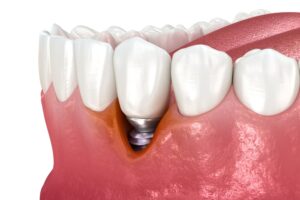 Peri-implantitis is a bacterial infection of the gum and bone tissue around a dental implant, similar to gum disease around a natural tooth. It typically develops gradually, often years after an implant is placed and heals, which is why it can catch patients off guard.
Peri-implantitis usually starts as peri-implant mucositis, inflammation limited to the soft gum tissue with no bone involvement yet. At this stage, it’s generally reversible with a professional cleaning and improved home care. If it isn’t caught, it can progress to peri-implantitis, where the infection begins to affect the bone anchoring the implant. Left untreated, this bone loss can eventually loosen and cause the implant to fail.
Symptoms of Peri-Implantitis
Peri-implantitis doesn’t always cause obvious pain in its early stages, which is part of why it can progress before a patient notices. Watch for:
- Red, swollen, or puffy gum tissue around the implant, sometimes looking darker or more purplish than healthy gum tissue nearby
- Bleeding when you brush or floss around the implant site, even with gentle pressure
- Pus or discharge from around the implant, sometimes with a bad taste or persistent bad breath localized to that area
- Gum recession, exposing more of the implant or crown than was visible when it was first placed
- A deepening gap or pocket between the gum and the implant that you may be able to feel with your tongue
- Looseness in the implant itself, typically a later-stage sign that bone loss has progressed significantly
If you notice any combination of these, particularly bleeding or discharge, have it checked promptly rather than waiting to see if it resolves, since peri-implantitis tends to progress rather than improve without treatment.
When It’s Not Peri-Implantitis: Mechanical Causes of Implant Problems
Not every implant problem involves the gums or bone. Several mechanical causes can produce alarming symptoms that are often straightforward to resolve.
A loose abutment screw is one of the most common reasons an implant crown feels wobbly or shifts slightly, and people often mistake it for implant failure. The screw connecting the crown to the implant post can loosen over time, especially under heavy chewing forces, and you can usually fix it with a simple tightening procedure.
A cracked or chipped crown can cause discomfort or sensitivity without putting the implant itself at risk, similar to damage to a natural tooth. This is a restoration issue rather than an implant issue, and you can usually fix it by repairing or replacing the crown.
Bite misalignment, where the implant crown doesn’t match your bite, can cause chewing discomfort with nothing to do with infection. This sometimes develops gradually as other teeth shift slightly over time, changing how your bite comes together.
Because these mechanical issues can look and feel similar to early peri-implantitis from the patient’s perspective, an exam is the only reliable way to tell them apart.
Early Implant Failure vs. Late Implant Failure
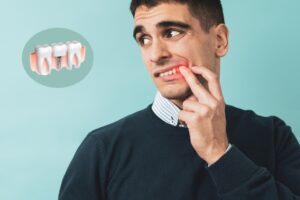 Implant failure isn’t limited to peri-implantitis showing up years later. Failure can also happen early, within the first few months after placement, if the implant doesn’t fuse with the jawbone through osseointegration. Early failure is less common and can result from infection at the surgical site, insufficient bone density that wasn’t fully addressed before placement, smoking during the critical healing window, or excessive force on the implant before healing is complete.
Late failure, occurring years after a successful healing period, is far more commonly linked to peri-implantitis that developed and progressed without being caught early. This is one reason regular checkups matter, even for implants that have been trouble-free for years.
Peri-Implantitis Risk Factors Worth Knowing
Certain factors raise the likelihood of peri-implantitis or implant complications in general:
- Smoking significantly increases risk at every stage, from initial healing through long-term gum health around the implant.
- A history of gum disease on your natural teeth is one of the strongest predictors of peri-implant disease, since the same bacteria can affect the tissue around an implant.
- Inconsistent home care lets bacteria build up around the implant, just as they would around a natural tooth.
- Uncontrolled diabetes can slow healing and impair the body’s ability to fight the low-grade infection involved in peri-implantitis.
- Untreated bruxism, or teeth grinding, puts excess mechanical stress on an implant, contributing to mechanical problems and, over time, bone stress around the implant site.
Our guide to caring for dental implants covers the daily habits that lower these risks.
How Peri-Implantitis and Implant Problems Are Treated
Treatment depends heavily on how advanced the issue is by the time it’s identified:
- Early peri-implant mucositis often responds well to a thorough professional cleaning around the implant, improved home care, and, in some cases, an antimicrobial rinse.
- Advanced peri-implantitis may require a deeper cleaning to remove bacteria from beneath the gum line, similar to scaling and root planing for natural teeth. Some cases need a minor surgical procedure to access and clean the area directly, sometimes paired with a bone graft to address bone loss.
- Mechanical issues like a loose abutment screw or a damaged crown are typically resolved much more quickly, often in a single visit, since there’s no active infection to treat.
- A failed implant that can’t be saved can be removed, and once the site has healed or been rebuilt with a bone graft if needed, Dr. Yenchesky can discuss placing a new implant.
Frequently Asked Questions
Pain appearing well after an implant has healed often signals peri-implantitis, an infection affecting the gum and bone around the implant. It can also be caused by a mechanical issue like a loose screw or a change in your bite. An exam and X-rays are the only reliable way to determine which one you’re dealing with, so it’s worth having it evaluated rather than waiting.
A loose feeling can come from a loosened abutment screw, a mechanical issue usually fixed with a simple tightening, or from bone loss around the implant caused by advanced peri-implantitis, which is more serious. Because these two causes require very different treatment, don’t assume it’s one or the other without having it checked. Avoid chewing on that side until you’re seen.
Patients with peri-implantitis may notice a persistent bad taste or odor localized to the implant site, often from pus or bacterial buildup beneath the gum line. This differs from general bad breath and is often noticeably worse around the affected implant. It’s worth mentioning specifically when you call to schedule an evaluation.
Yes. Early failure in the first few months usually relates to the healing process, but late failure years down the road is most often caused by peri-implantitis that developed gradually and went unnoticed early. This is why regular checkups matter even for implants that have never given you trouble.
A loose or painful implant isn’t always an emergency that needs same-day care, but you shouldn’t ignore it, since peri-implantitis tends to progress the longer it goes untreated. If you notice significant swelling, pus, fever, or sudden severe pain, contact our office right away. Our emergency dentistry page explains how we handle urgent visits.
Notice a Problem With Your Dental Implant? Call Fox View Dental
Whether it’s a simple mechanical fix or something that needs more involved treatment, the first step is an accurate diagnosis. Dr. Chad Yenchesky and the Fox View Dental team evaluate implant concerns for patients throughout De Pere, Green Bay, Ashwaubenon, and Allouez, WI. Call (920) 336-4201 today if something feels wrong with your implant.